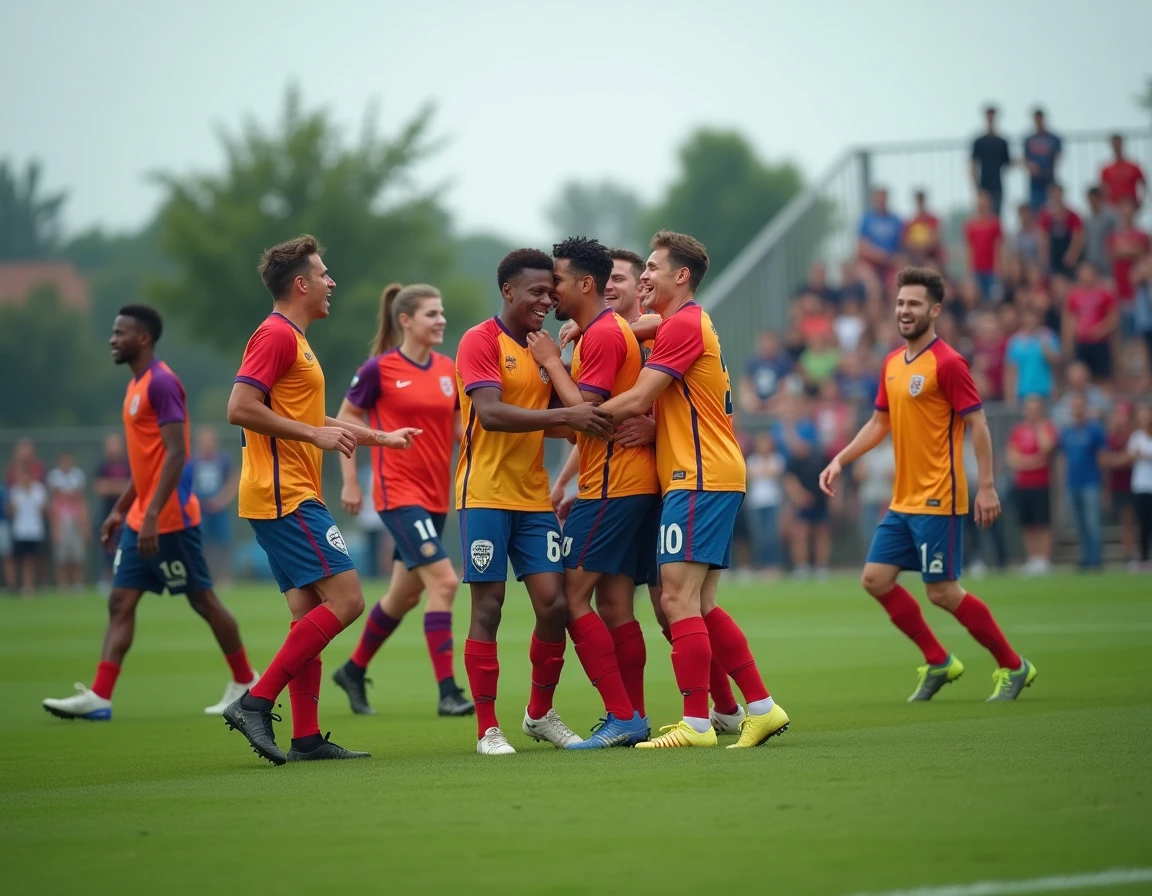
Three sources tell the same regional 1 match story on a Saturday night. The regional newspaper publishes a report with a focus on the local player. The club shares its result on its social media, accompanied by a group photo. The league updates its online ranking, without comment. The on-site supporter navigates between the three to piece together what actually happened on the field.
Regional press, club, and league: three narratives of the same match
Le Républicain Lorrain publishes a compilation of results every weekend covering football, basketball, and handball in Lorraine. L’Est Républicain offers a calendar-results for regional championships, including the Ligue Grand Est Régional 1. Le Progrès covers the national Ligue 1 but also the journeys of local athletes, such as cyclist Paul Seixas or Hyrox specialist Quentin Garel.
These regional newsrooms do a job that neither the club nor the league does: contextualizing a result. A raw score becomes a story when a journalist explains why a backup goalkeeper was given a starting position or how a series of injuries changed the tactics.
On the other hand, clubs control their own narrative. Clermont Foot, for example, directly manages its news on clermontfoot.com with a calendar, statistics, and supporter-oriented content. The club chooses what it shows and what it keeps quiet. Platforms like https://www.sportsland.fr/ attempt to gather regional sports news into a single entry point, addressing a need that neither the press nor the clubs cover alone.
The league, for its part, provides the raw data. The Local Professional Football League (LFPL) portal, for example, broadcasts a weekly match schedule, without analysis or narrative. In French-speaking Switzerland, the federation combines news, statistics, and rankings on a single portal, a model that French regional leagues have not yet systematically adopted.

Local sports information: what each source omits
The problem is not a lack of information. It’s fragmentation. Each source has a structural blind spot.
- The regional press covers widely but lacks depth on lower divisions. A Régional 2 match will often only have a score and two lines when mentioned.
- The club communicates about itself, never about its opponents, and rarely about the actual conditions of a match (disputed refereeing, unplayable pitch, hostile crowd).
- The league publishes structured data (schedule, results, rankings) but without any editorial layer. A forfeit or a postponement appears as a line in a table, without explanation.
Supporters who want to understand the dynamics of their local championship must therefore manually cross-reference these three streams. This situation has changed little in recent years despite the proliferation of digital channels.
The case of less publicized sports
Regional football captures the majority of local coverage. Basketball, handball, amateur rugby, or regional cycling receive more sporadic attention. Le Républicain Lorrain compiles results from several disciplines in a single article, which provides visibility but dilutes analysis.
For a handball player in Nationale 3 or a regional cyclist, regional sports news often remains limited to a result without context. In-depth profiles, like the one Le Progrès dedicates to Quentin Garel and his journey in Hyrox, remain the exception.
Regional sports results: the problem of real-time data
Major national media (L’Équipe, Ouest-France, France Info) have industrialized real-time coverage for major competitions: live scores, updated tables, videos. This infrastructure does not exist for regional sports.
A Régional 1 match in Ligue Grand Est ends at 5 PM. The result appears on the league’s website within a variable timeframe. The regional newspaper’s report arrives the next morning, sometimes on Monday. The club publishes on its networks within the hour, but without usable structured data.
The gap between the moment of the result and its contextualization can reach several days. For supporters present at the stadium, this matters little. For those following from a distance, the window of interest is short: a few hours after the final whistle.
Statistics and rankings in amateur sports
L’Est Républicain provides a calendar-results for regional football championships. This type of service, based on federal data, offers a useful factual reading. However, the available data does not allow for tracking individual statistics (scorers, cards, minutes played) below the national level.
The Swiss model, where the federation centralizes news and statistics on a single portal, shows that unified access is technically possible. On-the-ground feedback varies on this point: some French regional leagues invest in digital tools, while others still operate with manually updated PDF tables.
Local sports events: beyond football
Regional sports news is not limited to championships. One-off events (cycling races, youth tournaments, athletics competitions) constitute a significant part of local sports life. The Tour Auvergne Rhône-Alpes in cycling illustrates this category well: a regional event that serves as a springboard to the professional level.
The coverage of these events depends almost entirely on the regional press. Federations and leagues publish a calendar, sometimes a results statement. The storytelling, athlete profiles, and performance analysis remain the domain of local journalists.
- Regional cycling races receive decent coverage in the newspapers of the areas they pass through, but are invisible elsewhere.
- Youth competitions (football, judo, athletics) are rarely covered beyond the organizing club’s website.
- Emerging or niche sports (Hyrox, trail, urban sports) rely on social media and a few occasional profiles in the press.
The passion for local sport is transmitted as much through storytelling as through results. An updated ranking does not replace an article that tells how a youth team secured its survival on the last day. The question remains open: who will take charge of this narrative layer for the disciplines and levels that the regional press can no longer cover due to lack of resources.
French regional sports produce hundreds of results, performances, and stories every weekend. Information exists, but it remains scattered among actors who do not share the same tools or priorities. As long as raw data (league), editorial narrative (press), and institutional communication (club) remain compartmentalized, the on-site supporter will continue to piece together the puzzle of their Saturday sports experience alone.