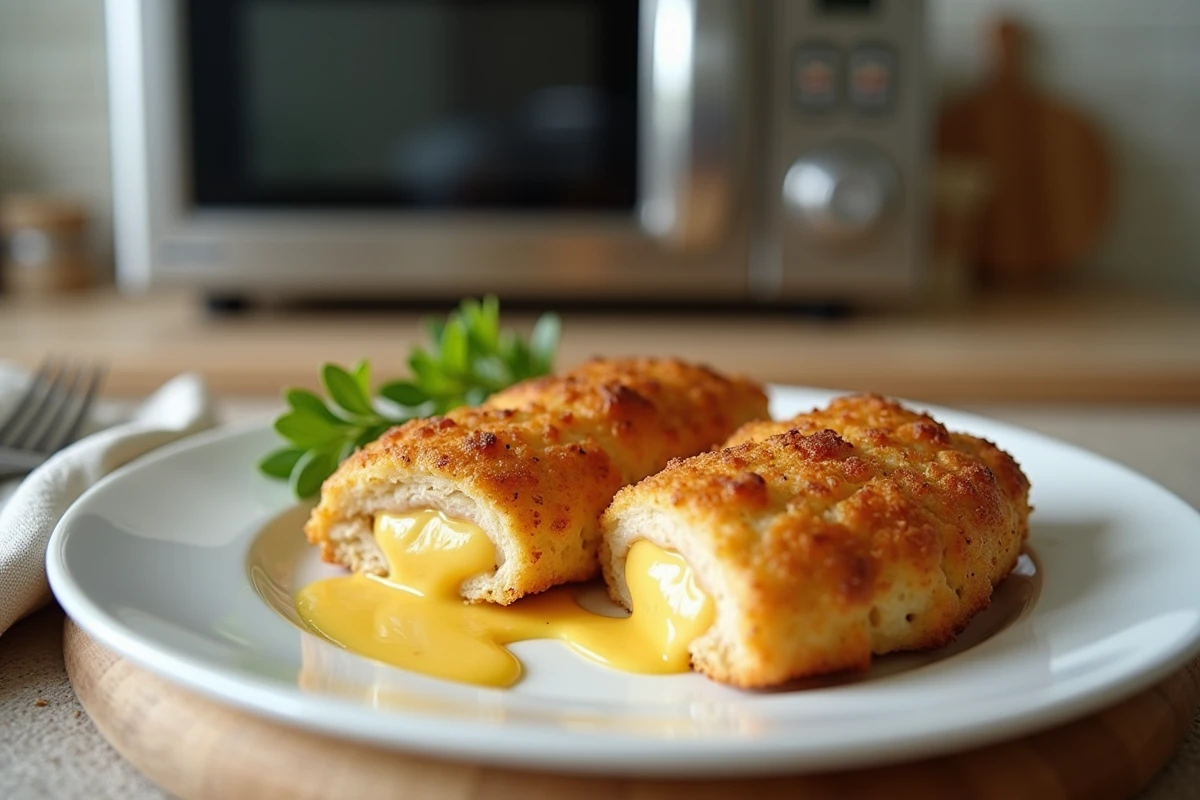
A cordon bleu taken out of the microwave can be burning hot on the outside and still cold in the center. This temperature discrepancy poses not just a comfort issue: it raises a real food safety concern, especially with poultry. Success depends less on a universal timing than on an adjustment suited to the type of product you have on hand.
Core temperature of the cordon bleu: the only reliable reference in the microwave
Most online advice gives a fixed duration. The problem is that a refrigerated fresh cordon bleu and a frozen cordon bleu do not have the same thermal starting point at all. The difference can represent several additional minutes of cooking.
The Anses has identified microwave cooking as one of the most risky methods for undercooking the center of breaded products, particularly those based on poultry. The reason: microwaves heat unevenly, creating cold spots where pathogenic bacteria can survive.
The real cooking indicator is not just the time displayed on the packaging, but the internal temperature. Poultry meat (chicken or turkey) must be cooked thoroughly to eliminate health risks. If you have a probe kitchen thermometer, insert it into the center of the cordon bleu after cooking: the heat must be uniform all the way to the core of the product.
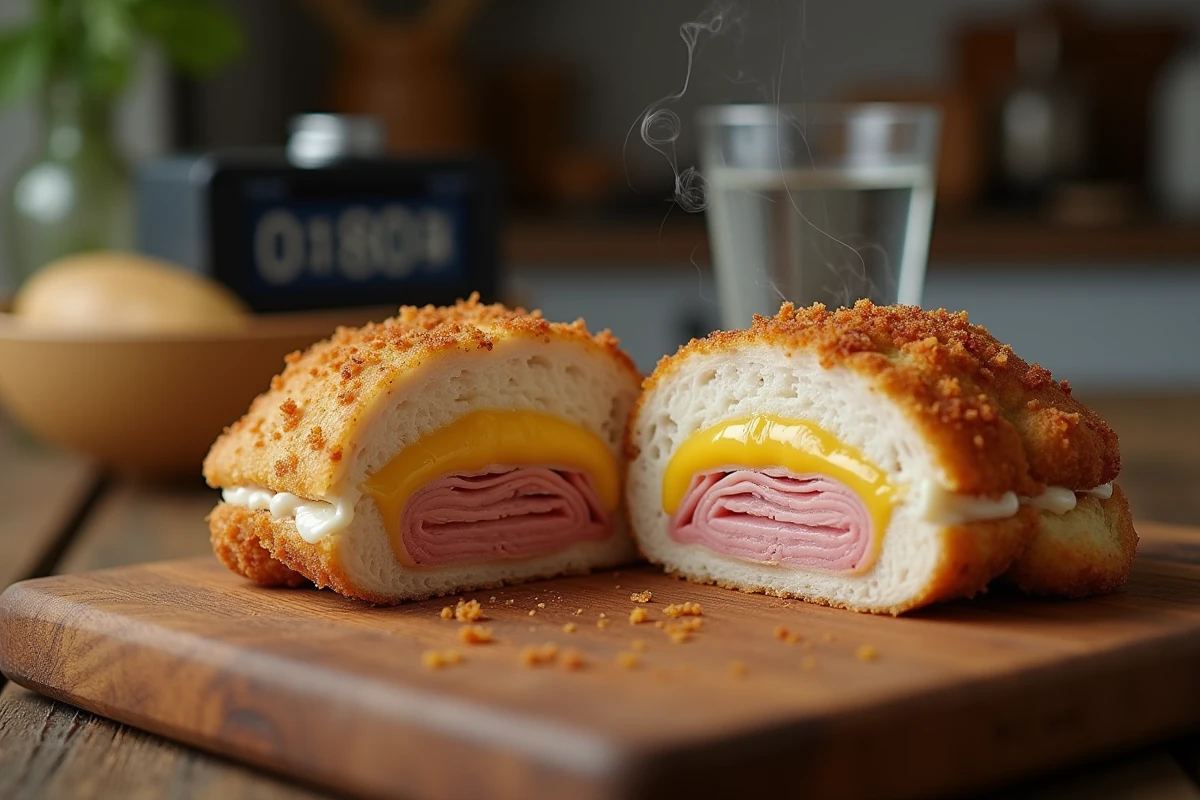
Have you ever noticed that the cheese oozes out from the edges while the meat seems barely warm in the middle? This is exactly the phenomenon of thermal heterogeneity. Cheese melts at a temperature much lower than that required to cook poultry. Thus, melted cheese does not guarantee a cooked cordon bleu.
To better understand how long to microwave a cordon bleu depending on each situation, you need to think in terms of product category rather than generic duration.
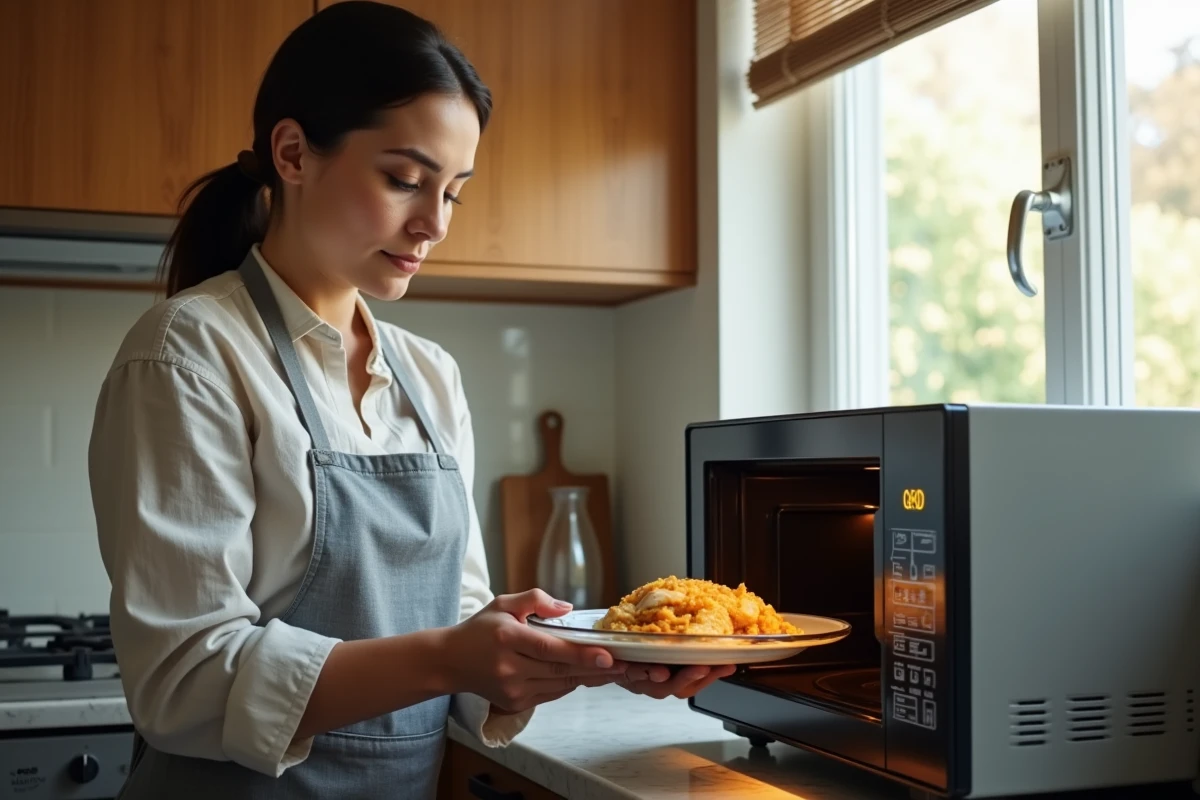
Frozen, refrigerated, or fresh cordon bleu: adjusting the microwave power
A frozen cordon bleu starts from a negative temperature. A refrigerated cordon bleu comes out of the fridge at around a few degrees. A fresh homemade cordon bleu is at room temperature. These three situations require different settings.
Frozen: defrost before cooking
Putting a frozen cordon bleu directly on full power is the main source of failure. The outside overheats, the breading softens due to the moisture released during defrosting, and the center remains frozen.
Start with a defrosting phase at reduced power. Use your device’s defrost function or manually set it to about half of the maximum power. After this step, let it rest for a minute to allow the heat to distribute, then proceed to the actual cooking at a higher power.
Refrigerated (national brand or private label)
The cordon bleus sold in the refrigerated section are mostly already cooked or precooked. This is then a reheating process. Several food safety guides emphasize that private label brands may have different cooking recommendations from those of major brands. These discrepancies are not trivial: they reflect the internal validation tests of each manufacturer, calibrated to ensure the elimination of pathogenic bacteria.
Read the packaging. If the manufacturer indicates a microwave time, follow it exactly rather than applying a duration found elsewhere. The Anses explicitly recommends following the cooking methods printed on the package, especially for sensitive populations (children, elderly, pregnant women).
Homemade or fresh uncooked
A raw homemade cordon bleu, with a chicken or turkey fillet filled with ham and cheese, poses an additional challenge. Raw meat requires thorough cooking, not just reheating. The microwave alone is not the most suitable method for this scenario, as achieving even cooking of breaded raw meat remains difficult with waves that penetrate unevenly.
If you insist on using the microwave to save time, use it only for the first cooking phase (bringing the meat to temperature), then finish in a pan to crisp the breading and confirm the cooking in the center.
Crispy breading in the microwave: limits and combined technique
The microwave works by agitating water molecules. Breadcrumbs contain little water: they do not crisp up, they soften due to the moisture released by the meat and cheese. No power setting will change this basic physics.
To limit damage to the texture of the breading:
- Place the cordon bleu on a sheet of absorbent paper that will capture some of the excess moisture during cooking.
- Do not cover the cordon bleu with an airtight lid, which traps steam and turns the breadcrumbs into a sponge. A simple paper towel placed on top is enough to prevent splatters without creating a steaming effect.
- Flip the cordon bleu halfway through cooking to expose both sides more evenly to the heat.
Finishing in a pan remains the only method to regain crispiness after a microwave pass. Heat a drizzle of oil or a knob of butter in a hot pan, then sear each side for one to two minutes. This combination of microwave then pan yields a result significantly superior to the microwave alone.
Common mistakes with the cordon bleu in the microwave
Some habits seem logical but degrade the result:
- Cooking several cordon bleus stacked or touching each other. The waves do not penetrate evenly when the pieces overlap. Space them out on the plate.
- Setting the power to maximum to go faster. Too high a power dries out the edges before the center is hot. Better to use medium power and a few extra seconds.
- Ignoring the resting time. After cooking, let the cordon bleu rest for about thirty seconds outside the microwave. The internal heat continues to distribute and equalizes the temperature between the center and the surface.
- Relying solely on the golden appearance of the oozing cheese. As explained above, cheese melts well before the poultry is cooked through.
The cordon bleu in the microwave remains a compromise between speed and texture quality. For an express meal, the method works as long as you follow the manufacturer’s instructions and check the internal cooking. For sensitive populations, an additional pass in the pan or oven is not a luxury; it is a food safety precaution to take seriously.