
A T3, according to French regulations, must offer a minimum space of 9 m² per bedroom. However, many apartments rarely exceed 60 m², imposing sometimes restrictive layout choices. Removing a hallway can free up several usable square meters, but often leads to less fluid circulation.
Some transformations are allowed without a permit, while others require prior declaration. Acoustic insulation or ventilation standards sometimes limit the possibility of creating an additional room, even if the area seems sufficient on paper. Optimizing a T3 thus involves technical, regulatory, and practical trade-offs.
What does a T3 look like in daily life?
In a T3 apartment, every centimeter counts and every use must find its place. Two bedrooms, a living room, a kitchen that can be open or separate, a bathroom, a hallway often present, and sometimes a balcony. One moves within a defined space where the area and the number of rooms in a T3 directly influence comfort, freedom of movement, and possible intimacy for everyone.
The minimum area of a T3, regulated by the Carrez Law and Decree No. 87-149, generally varies between 55 and 70 m², depending on the city and the construction period. In Villeurbanne and elsewhere, the goal is to find balance: two real bedrooms to maintain comfort, a spacious enough living room to host family and friends, a functional kitchen, all without forgetting a ceiling height that avoids a feeling of suffocation.
Comfort is not just about the area. It depends on the layout, how the main rooms are arranged, and the flow from one space to another. Acquiring a T3 often means accepting certain compromises: the budget, the strategy of real estate investment, or the prospect of reselling later. Value is determined by the quality of the layout, modularity, natural light, and tranquility. A T3 apartment thus requires special attention: how to enhance every square meter, maintain fluid movement, and make daily life pleasant and suitable for the whole family?
What pitfalls should be avoided to not lose space?
The square meters of a T3, often fiercely negotiated, can disappear due to awkward layout choices. Priority should be given to circulation: multiplying bulky furniture, adding unnecessary partitions, or placing poorly thought-out storage divides the space and shrinks the central room. To create an impression of openness, it’s better to invest in multifunctional furniture or custom solutions. A sofa bed, an extendable table, and built-in storage up to the ceiling can free up the floor while structuring the space.
The most common mistake remains neglecting the ceiling height: settling for low storage loses valuable possibilities. Installing high shelves, full-height wardrobes, or a custom bookshelf maximizes space without compromising style. Another pitfall: sacrificing brightness. Heavy curtains, solid doors, or a lack of mirrors darken and shrink the volumes. To enlarge each room, it’s better to multiply light sources and choose light colors.
Hiring an interior designer often helps optimize the configuration in the long term. But if that’s not feasible, every nook should be scrutinized: every corner, every surface can serve a purpose. It’s better to open up the main spaces, avoid unnecessary hallways, and care for the transition between the kitchen, living room, and bedrooms. In a T3, nothing is left to chance: every choice affects comfort and practicality.
Concrete tips to transform every square meter into a pleasant living space
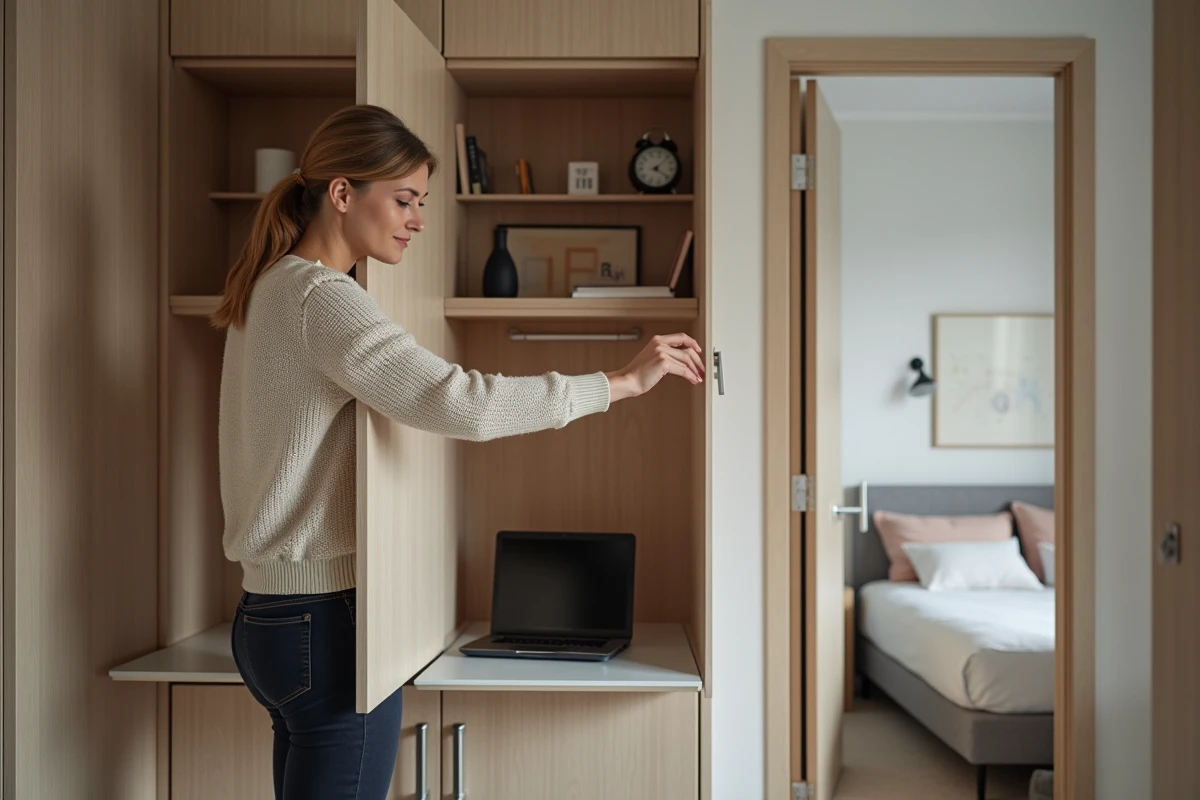
To improve comfort and quality of life in a T3, every corner deserves special attention. Installing a discreet office corner in a corner of the living room or a bedroom allows for remote work without invading the space. A simple foldable wall shelf, accompanied by a lightweight chair, does the trick. In a child’s room, a loft bed frees up the floor to create a play area or accommodate a small desk.
The dressing can fit behind a lightweight partition or in a niche, transforming a lost space into useful storage. In the living room, a storage bench aligned against the wall serves both as seating and an invisible storage solution. The dining table, compact and modular, can be stored against the wall when not in use.
Here are some solutions to make the most of every square meter:
- Set up a preparation area under the window in the kitchen: natural light amplifies the space and makes daily tasks more enjoyable.
- Create a discreet laundry area in a deep closet or under a countertop: the washing machine and storage disappear without harming the overall harmony.
- Use a tall bookshelf to create a light separation between the living room and dining room, without blocking light or breaking the perspective.
The layout should remain flexible: a room can become a home office, playroom, or guest bedroom depending on current needs. To visually enlarge, multiply perspectives, opt for transparency (glass partitions, glass doors), and choose less bulky furniture. Nothing replaces a well-thought-out plan, tailored to actual uses.
A well-designed T3 promises a space that breathes, an obvious flow, a daily life where every square meter counts without ever feeling heavy. Over time, the apartment evolves with its occupants, adapts, and reinvents itself. This is where comfort truly makes sense.